When I was a little girl, I was very interested in everything about
Egypt, especially the gods and goddess, the pyramids, the myths, the daily-life of people and the hieroglyphics. So, when I found out that there would have been an
exhibit about Ancient Egypt at MUDEC in Milan, I bought the ticket (
here the link of the exhibit).
The exhibit in particular is about the life and figure of
Pharaon Amenhotep II (1427-1401 BC) in the so-called "
Golden Age". A lot of museums, such as the
Egyptian Museum in Cairo, the
Stichting Rijksmuseum van Oudheden in Leiden, the
Kunsthistorisches Museum in Vienna and the
National Archaeological Museum in Florence and other private collections have loaned for this occasion a lot of materials (statues, mummies, weapons...), to show the
importance of this Pharaon, often eclipsed by the fame of his father Thutmose III, and the
archaeological "rediscovery" of the finding of the tomb in the Valley of the Kings.
 |
| http://www.mudec.it/eng/ |
In this post I will show some
photos I took and I write also some
information I didn't know before visiting the exhibit.
Let's start from the
Pharaon itself: who was Amenhotep II? I'll show you the
family tree I wrote:
As you can see, Amenhotep II was a not-so-far ancestor of the famous Tutankhamen; instead, his father, Thutmose III was responsible of the creation of the largest empire Egypt had ever had: also, he ruled for almost 54 years (including 22 years when he was co-regent with his stepmother and aunt).
His son, Amenhotep II, wanted to emulate his father's achievements: this is proven also seeing the statues of Thutmose III and Amenhotep II, which are very similar in shape.
At the exhibit there was also a statue of a
high dignitary who lived during the reign of Thutmose IV, whose name was
Tjenena: the
name and
titular on the base of the statue had been deliberately
erased, as a punishment for those who fell into disgrace.
I also took the photo of a
stele, where it can be seen god
Anubis (associated with mummification and afterlife) and god
Osiris (god of transition and resurrection) on the left during an offering.
There were also
papyruses, as the "
Papyrus of Kenna" and the "
Papyrus of Pashed": these are two fragments of a Book of the Dead and they are a result of the practice of
cutting up papyruses for sale on the
antiquities market. They were part of the scroll of a
nobleman who lived at the end of the 18th dynasty, as evinced by the
realistic representation of the deceased.
The "Papyris of Pashed" is a refined example of those from the New Kingdom: the vignette is elegantly drawn and the writing provides an excellent example of
cursive hieroglyphs.
I saw some
scarabs, as these ones: one of them has on its base the writing "the perfect god
Amenhotep III", and the name of his Great Royal Wife Tiye, while the other, called "
heart scarab", was placed on the mummy, above the heart. It is inscribed with the 30th formula of the Book of the Dead which beseeches the heart not to testify against the deceased at the tribunal of the gods.
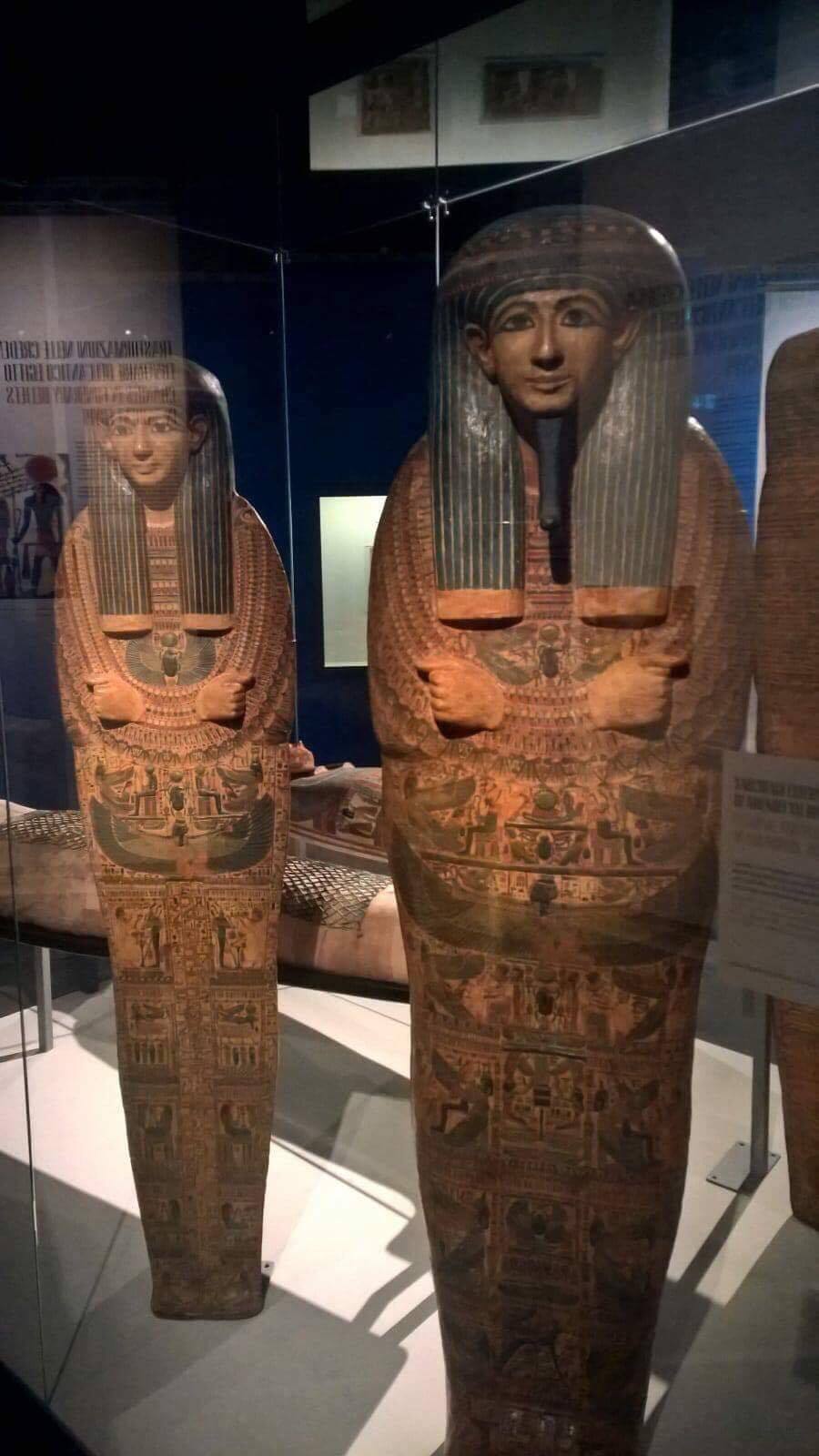
It can be seen also the
external and
internal sarcophagi of Amenhotep (21st dynasty): it is not easy to have two sarcophagi of the
same person, which were intended to fit one inside the other.
There was also a
photo of the position of the
sarcophagus of Amenhotep II at the moment of his
discovery:
------------------------------------------------------
I hope you enjoy this post: if you like my blog, you can follow it to stay tuned with all my new posts!
Bye for now
Yours, Silvia